

Children’s Rights is a national nonprofit organization dedicated to improving the lives of children and families impacted by government systems, including child welfare, juvenile justice, immigration, education, and healthcare. Through a combination of legal advocacy, policy reform, and collaboration, the organization works to hold systems accountable and ensure children are safe, supported, and protected.
Community Matters:
Meet Children’s Rights
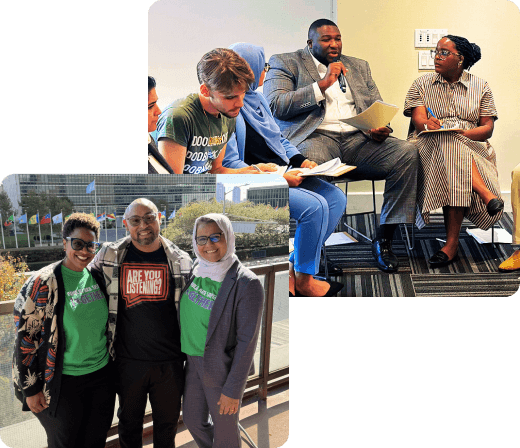

What is the mission of Children’s Rights?
Children’s Rights is dedicated to improving the lives of children and families affected by America’s child welfare, juvenile legal, immigration, education, and healthcare systems. Our lawyers and policy experts work in tandem to end unnecessary family separation and hold government accountable for keeping kids safe and healthy.
Where does Children’s Rights operate?
We are based in New York, but our impact is nationwide. In partnership with advocates in 29 states, we have improved conditions for nearly three million children across the U.S., along with tens of thousands of families affected by unjust child welfare surveillance and unnecessary family separation. Children’s Rights represents nearly 20% of all children in state foster systems and every immigrant child in federal detention.
What was the catalyst for starting the organization? How has it evolved over time?
Children’s Rights was founded in the mid-1990s on a simple but powerful premise: children in government care deserve the full protection of the Constitution, and the courts can be a powerful tool to hold public systems accountable when they fail to protect children.
We became known for bringing class action lawsuits on behalf of children whose safety and wellbeing were being jeopardized by poorly functioning state systems. Over time, our work expanded beyond traditional foster system reform to address broader civil rights issues affecting children across other government systems, including immigration, mental health, and juvenile justice. This shift reflects the reality that many children experience overlapping forms of vulnerability.
In the last ten years, we have more than doubled our geographic reach and adopted a holistic model that pairs high-stakes litigation with policy work, research, and coalition-building. Today, we are widely recognized as a leading national advocate for children’s civil rights.
In one word, what sets Children’s Rights apart from other organizations?
Accountability.
Why does accountability matter for the communities you serve?
Because the children we serve often have no other source of power. I think about the searing images and stories of immigrant children being detained by the federal government in horrific conditions, filled with fear and uncertainty. Then I think about my own three children, who know they are safe and protected. Their parents are their voice.
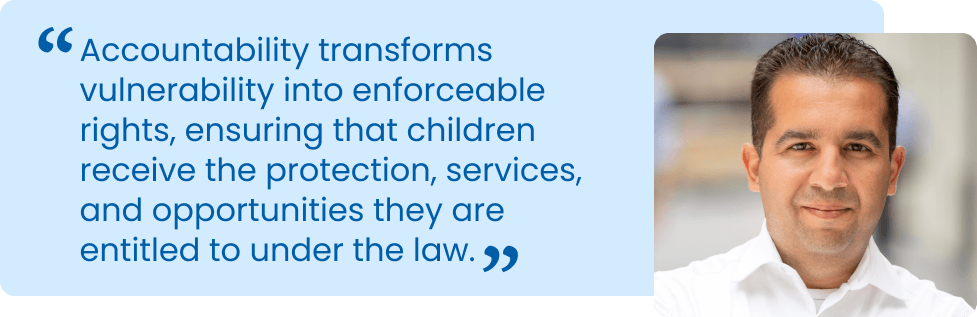
Children living within these systems often have no one to advocate for them. Children’s Rights ensures they are not ignored. When we succeed, courts and lawmakers require governments to follow the law and meet basic standards of care. In this way, accountability transforms vulnerability into enforceable rights, ensuring that children receive the protection, services, and opportunities they are entitled to under the law.
What are you most excited about for the future of Children’s Rights?
I am excited about our growing ability to drive systemic change at a national scale. Our expanded reach and holistic approach position us not only to win important cases, but also to help reimagine how systems operate so that fewer children and families are harmed in the first place. Momentum is on our side, and I look forward to building on it to create systems that respect children’s rights, support family integrity, and deliver the care and stability every child deserves.
What’s one piece of advice you would give to other nonprofit leaders to help them be successful?
In the nonprofit sector, there are constant pressures—from funding cycles to shifting political winds—that can pull organizations in many directions. Leaders need to remain grounded in their mission and the people they serve, while staying flexible enough to respond to emerging needs within their communities.
What impact does having the right banking partner have on your organization?
Children’s Rights manages complex funding streams for litigation, policy initiatives, and advocacy programs across more than 20 states. A strong banking partner is critical to the stability, efficiency, and growth of our work, ensuring that financial operations are secure, reliable, and scalable. The right partner also allows leadership to stay focused on mission-driven work rather than administrative challenges, with confidence that our finances are in capable hands.
Can you tell us about your partnership with your banker? How did it begin, and how has it evolved?
A board member introduced us to Sam Sidhu and his exceptional team. From the start, it was clear this would be more than a typical banking relationship. Customers Bank has gone beyond traditional banking services, providing financial guidance and support while also offering space and hosting events that help us engage young people who have experienced the foster system.
Over time, we have developed a close, collaborative partnership built on trust and a shared commitment to our mission.